Category Archives: evergreens

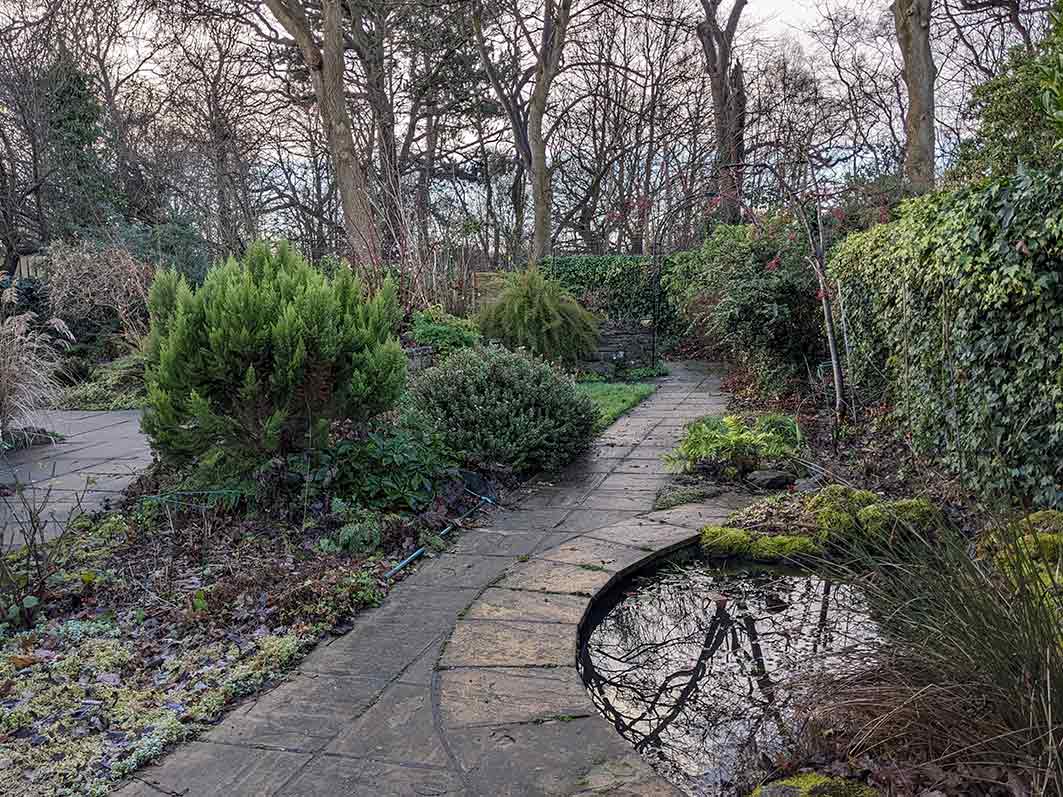
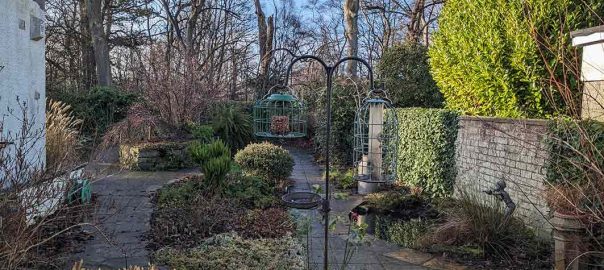
View of the garden at the end of January 2026 shows some evergreen shrubs and ivy and a wild life pond.

End of Jan 2026 in the garden.

Moan, moan ,moan, yet another cold and soggy winter.   We finally got a short spell of sunshine the other day so I nipped out into the garden to see what had started to come through.  The usual snowdrops, narcissi, a few crocus, hellebores, and yellow erythronium are just coming up.  Some of the hellebores have buds, some have a couple of open flowers and others only have leaves.  The old leaves need to come off as they are pretty manky looking and new leaves will pop up soon.
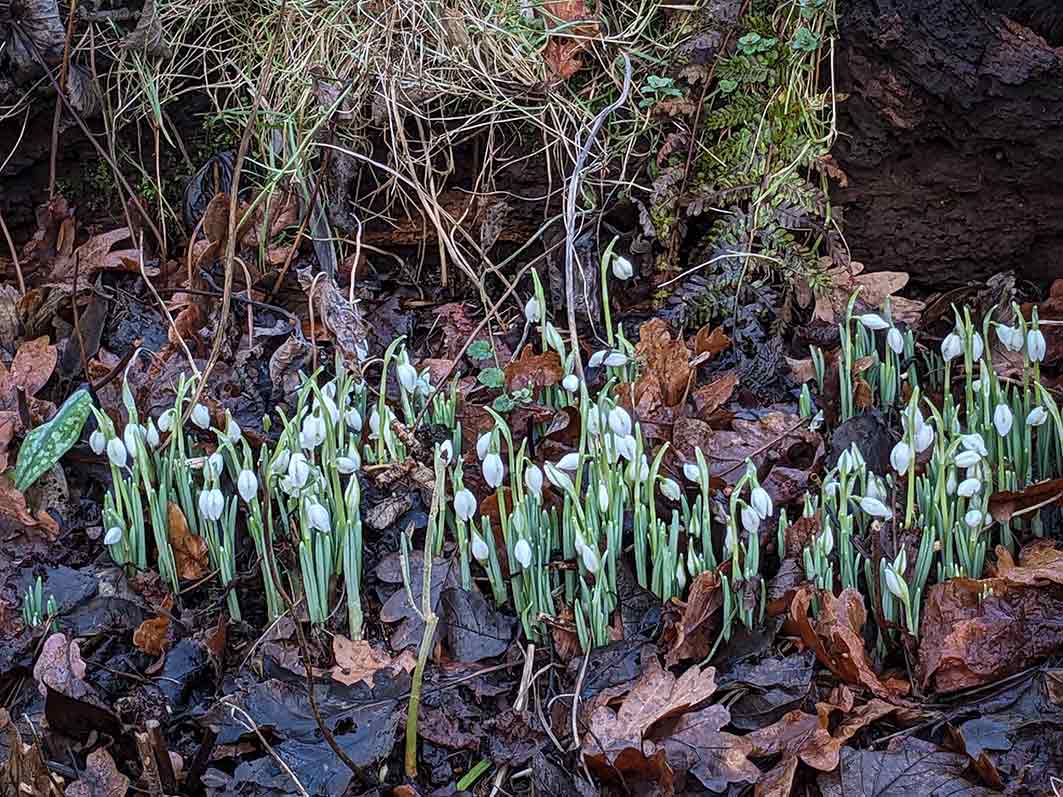
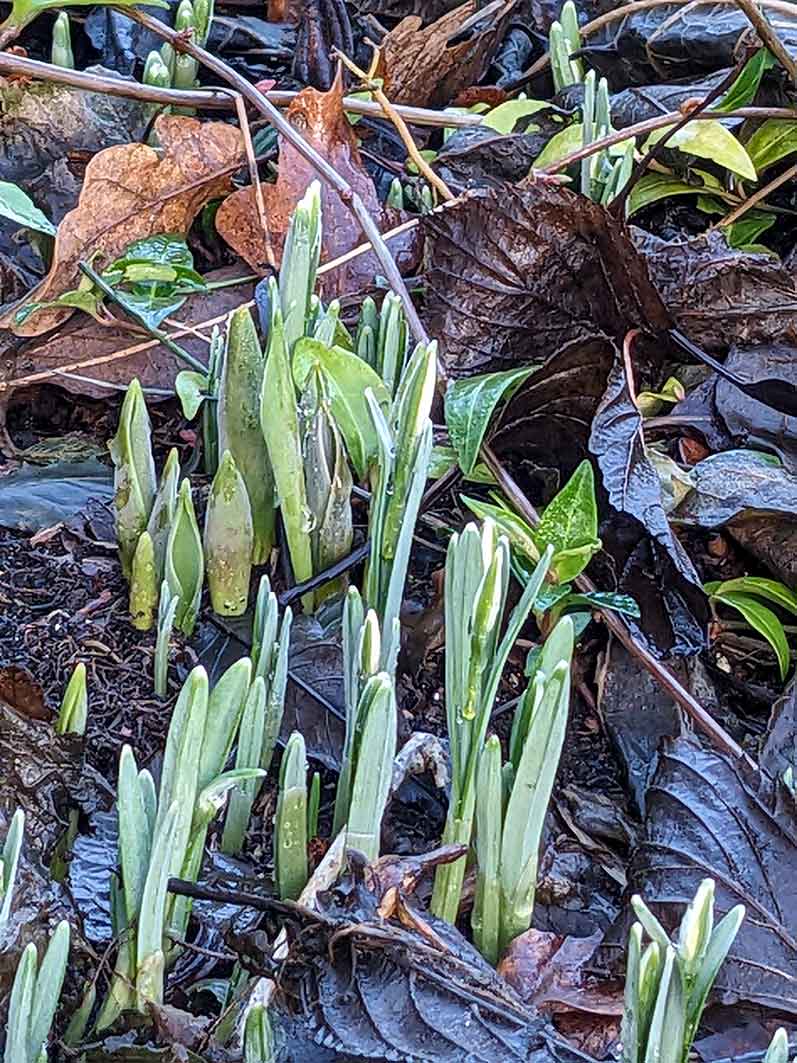
White snowdrops in bud on a carpet of wet, brown leaves.  Mossy log behind them.
Budding snowdrops.
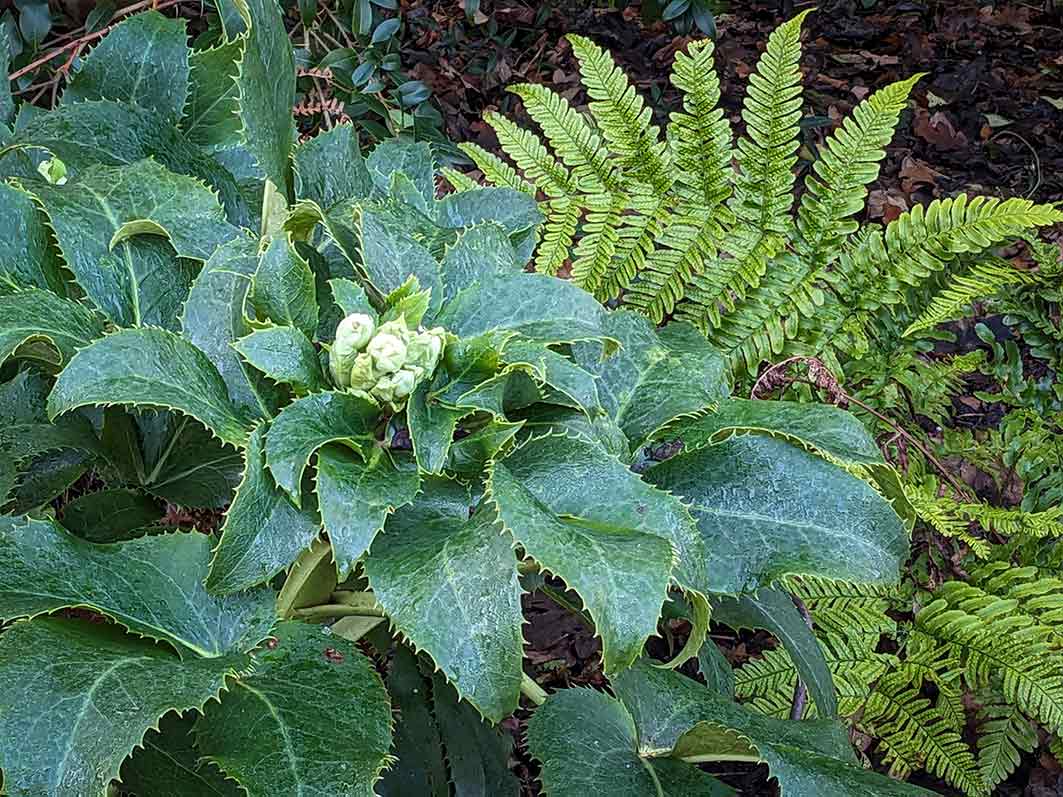
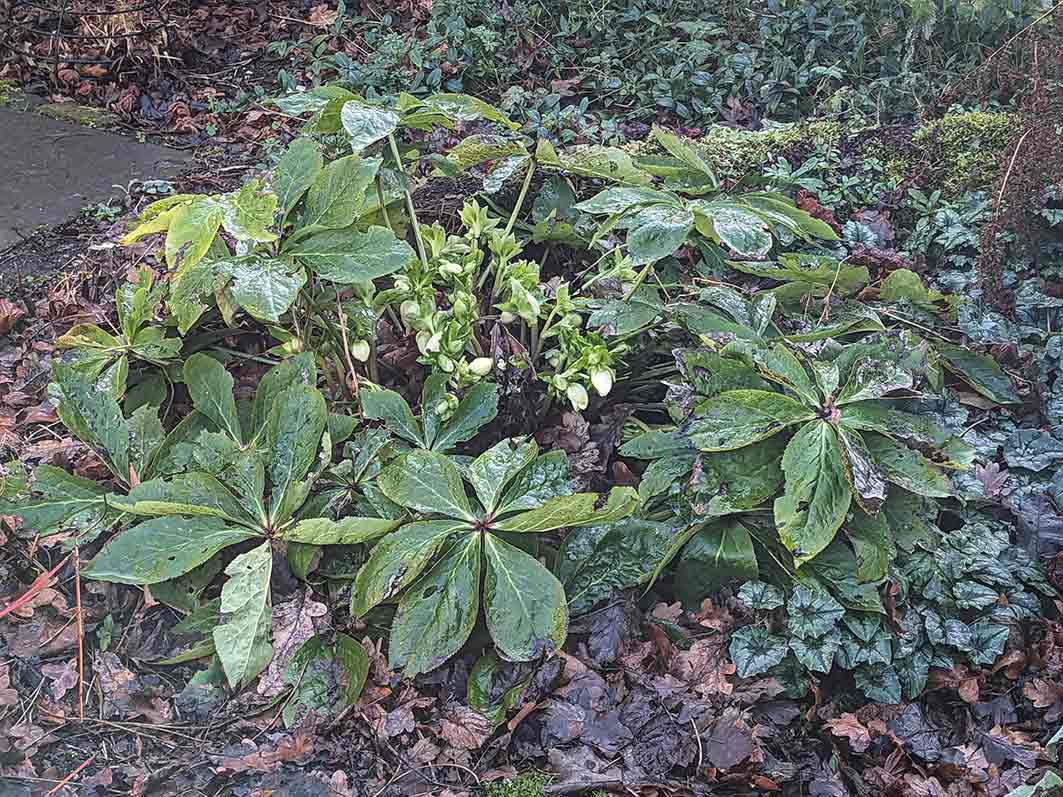
White hellebore buds surrounded by manky leaves.
White hellebore buds.
Pale green buds of hellebore argutifolius.
Hellebore argutifolious buds.
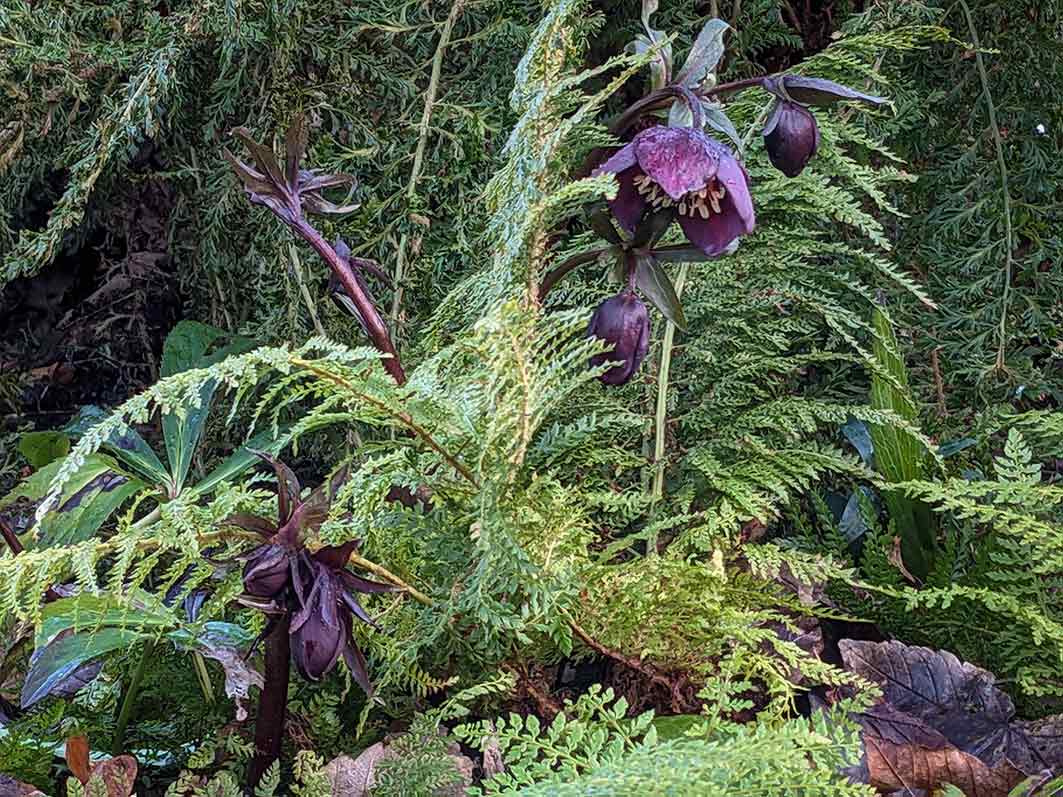
Deep purple hellebore buds and young flower with a fern growing through the plant.
Deep purple hellebore.

The rhododendron and the pieris have promising buds and hopefully (if I can keep the pigeons off) the choiysia will have some buds too.  The sarcococca has a few buds on, the lonicera fragrantissima (winter flowering honeysuckle) only has a few flowers so far, but it did get a prune in autumn as the branches were overhanging the path. The corkscrew hazel has a few catkins on but the witch hazel only has a few brown wizened leaves on it.  It usually has beautiful spidery orangey-red flowers on by now.  I do hope it is ok. This is what it looked like this time last year.   I have asked around and some people think it may not have had enough water during the summer (well I was on bed rest most of the summer) while others think it may be wind scorch.  It may well be dead but I have tried the scrape the bark test shown here Is my tree dying?   and just can’t make up my mind if it is or isn’t so I will just leave it alone and see what happens. The leaves did put on a bit of an autumn show but then just went very dark brown and didn’t really fall off.  There are some buds but they look small and skinny so I am a bit perplexed as it has been in that position for 12 years now and was only 3 meters away before that – we moved it when we got rid of the greenhouse and made the stumpery.
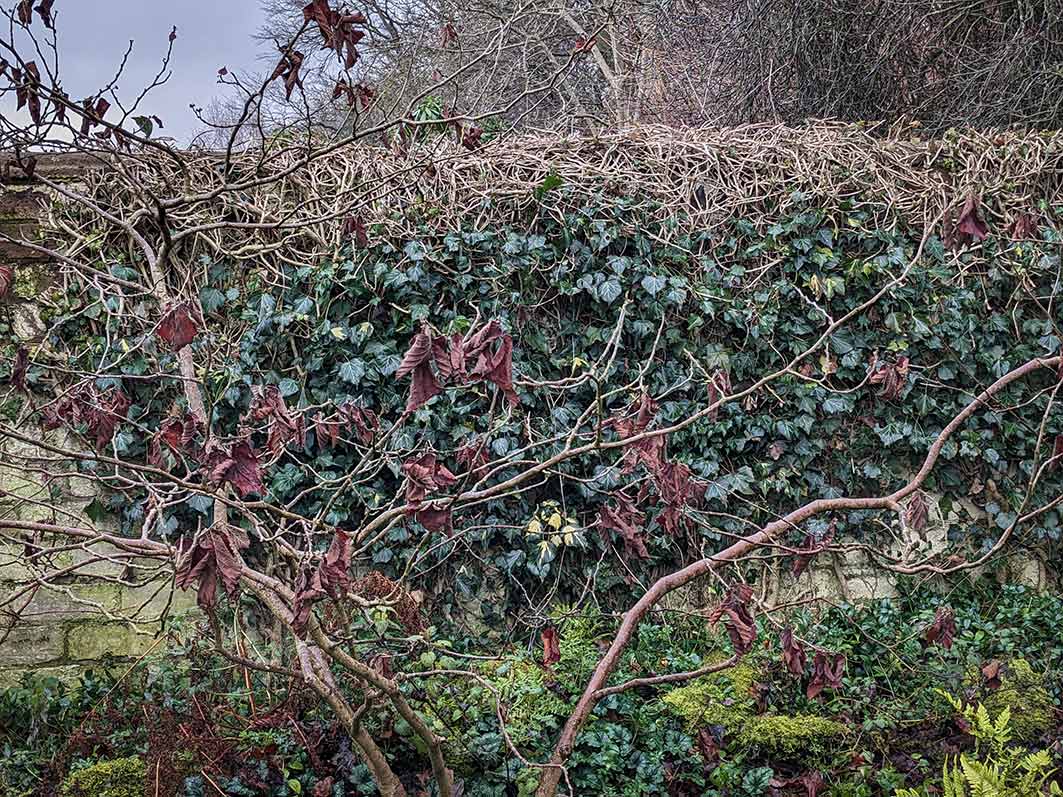
Brown leaves on a dead looking witch hazel shrub.
Dead looking witch hazel.

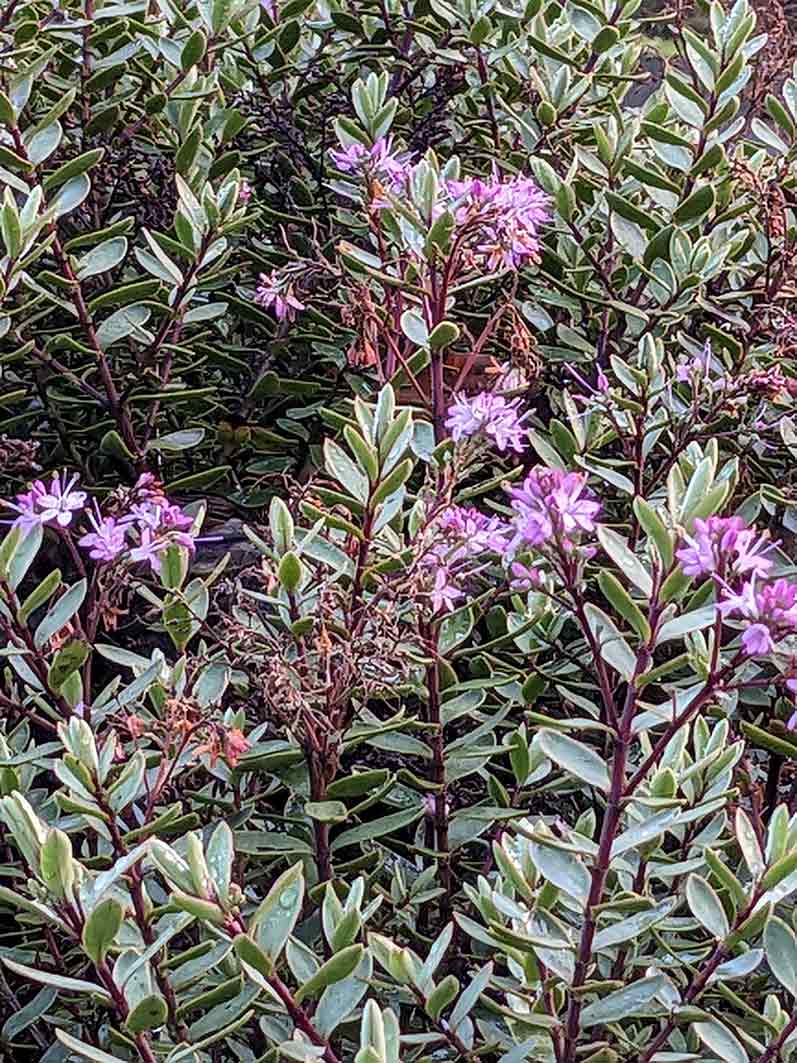
The hebe Pink paradise always has a few sporadic flowers on it as does the viburnum Bodnantense Dawn.  I took out a lot of the golden Japanese rush (Acornus Ogon) as it was creeping everywhere and getting in amongst the roots of other plants but it is a nice golden colour in a winter garden when potted up in a window box.  However it needs a bit of TLC now.    It lives under the bird feeder, behind a the rose Gertrude Jekyll,  as it not only helps prevent the seeds from the feeder getting into the bed, but also stops the rush getting out and spreading through the bed.
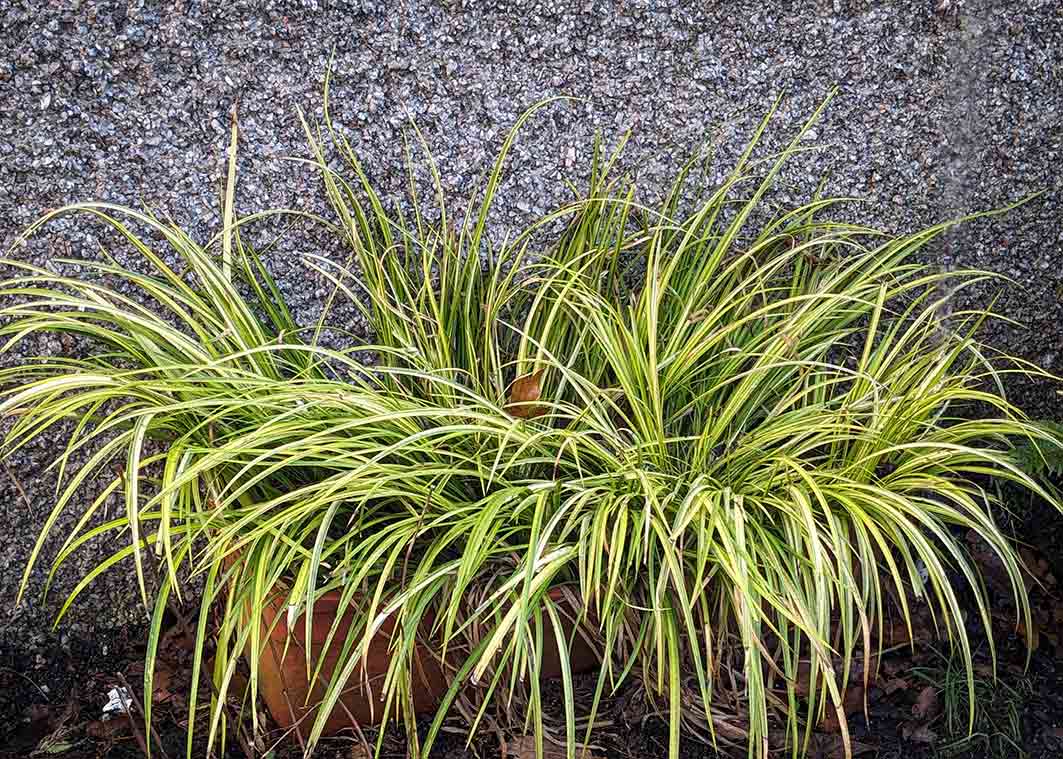
Golden green Acornus Ogon rush in a window box.
Acornus Ogon

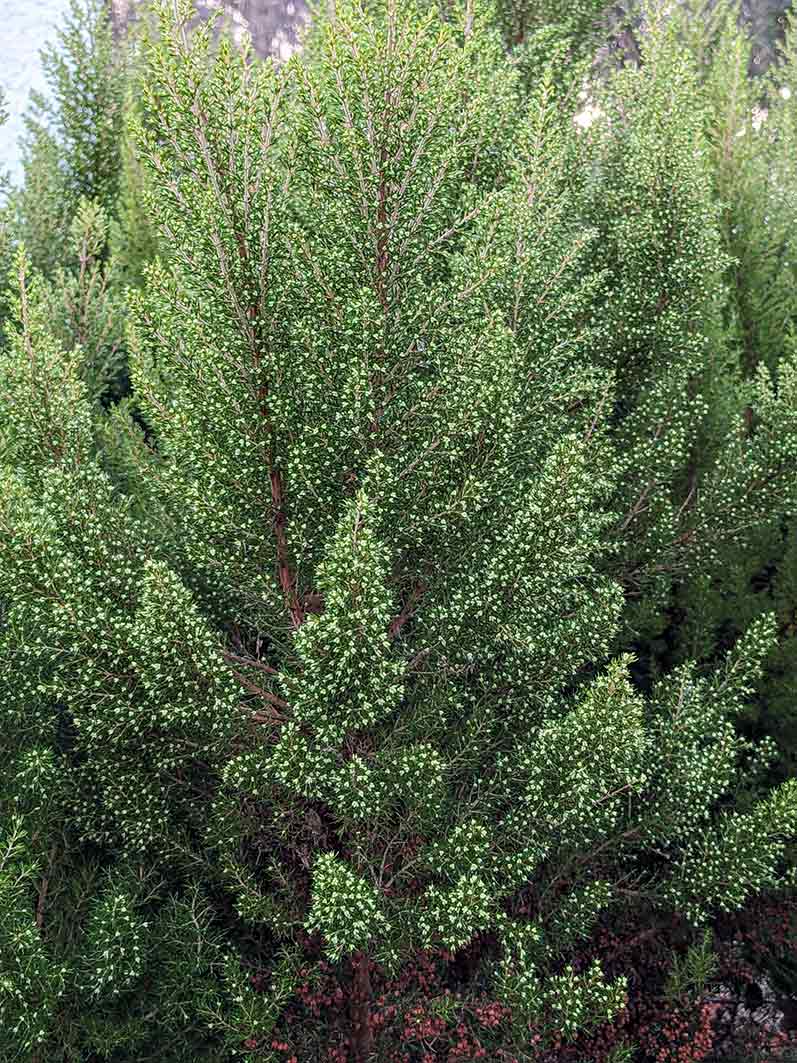
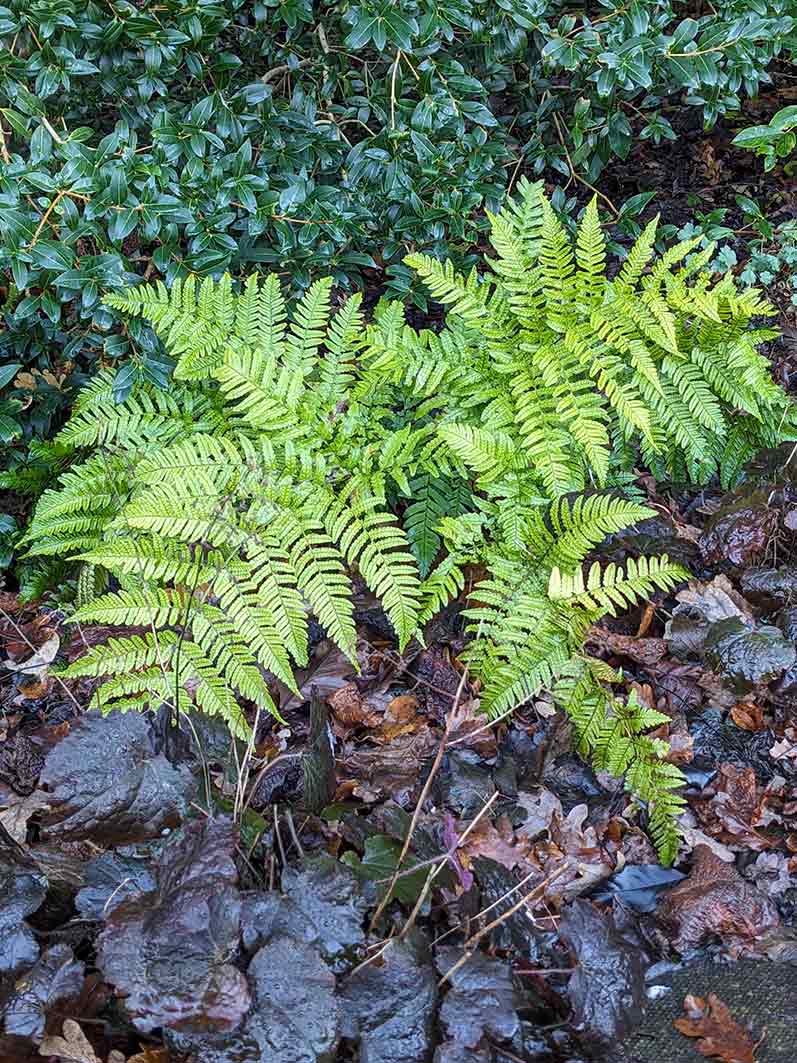
There are loads of evergreen to see in all parts of the garden to break up the browns and greys of winter.  A lot of ivy and ferns, cyclamen, heather, hebe, sarcoccoca, berberis, variegated holy, tree heath, epimedium, some grasses, and the saxifrages and succulents.  Even the young foxgloves and dead-nettles look ok during the winter.

At this time of year when the sun is still low we don’t get much sun sunshine in the garden.  I can see it flooding the golf course out the back and I can see it across the playing field out the front, but not much gets into the garden.
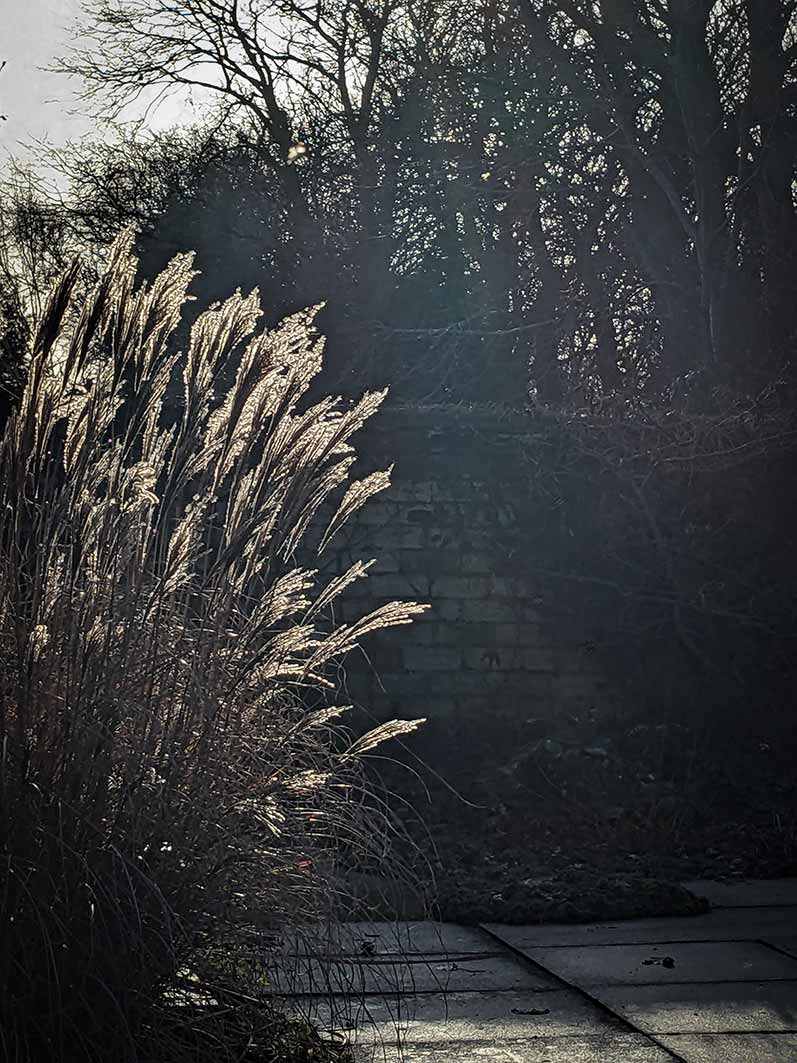
Old miscanthus grass seed heads back lit in the suns rays.
Miscanthus in the winter sun.

The conservatory gets a little bit more, but only for a short time and the patio only catches some rays on the table top through the conservatory window.

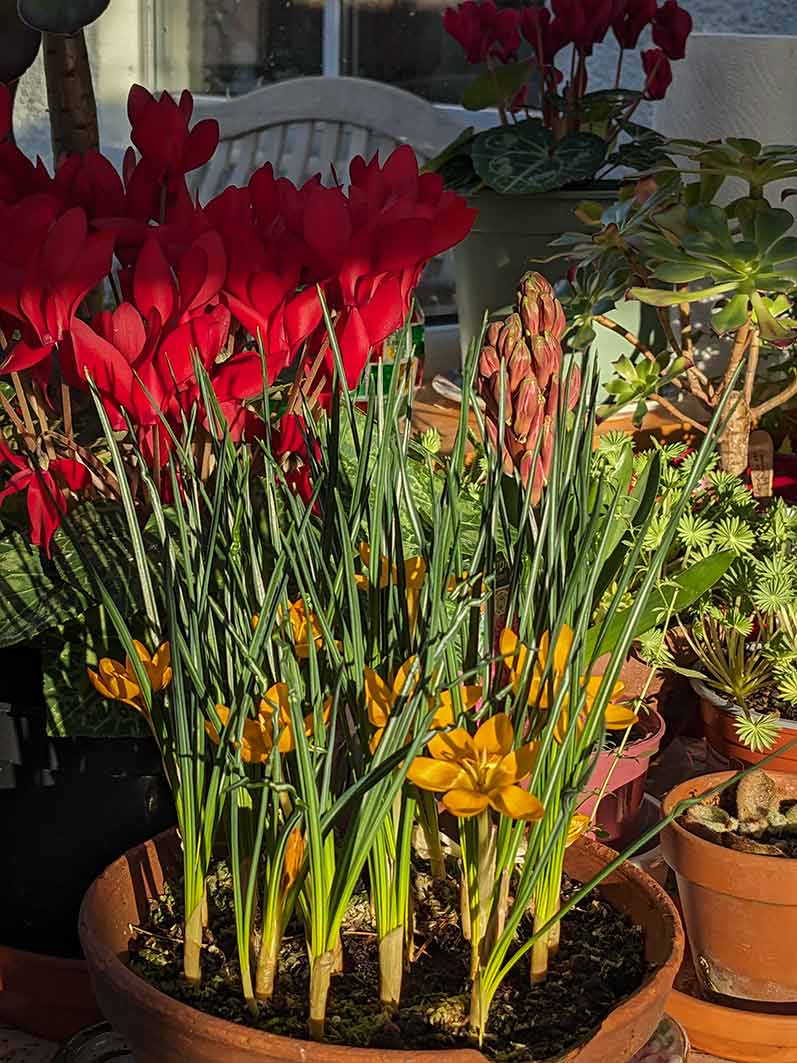
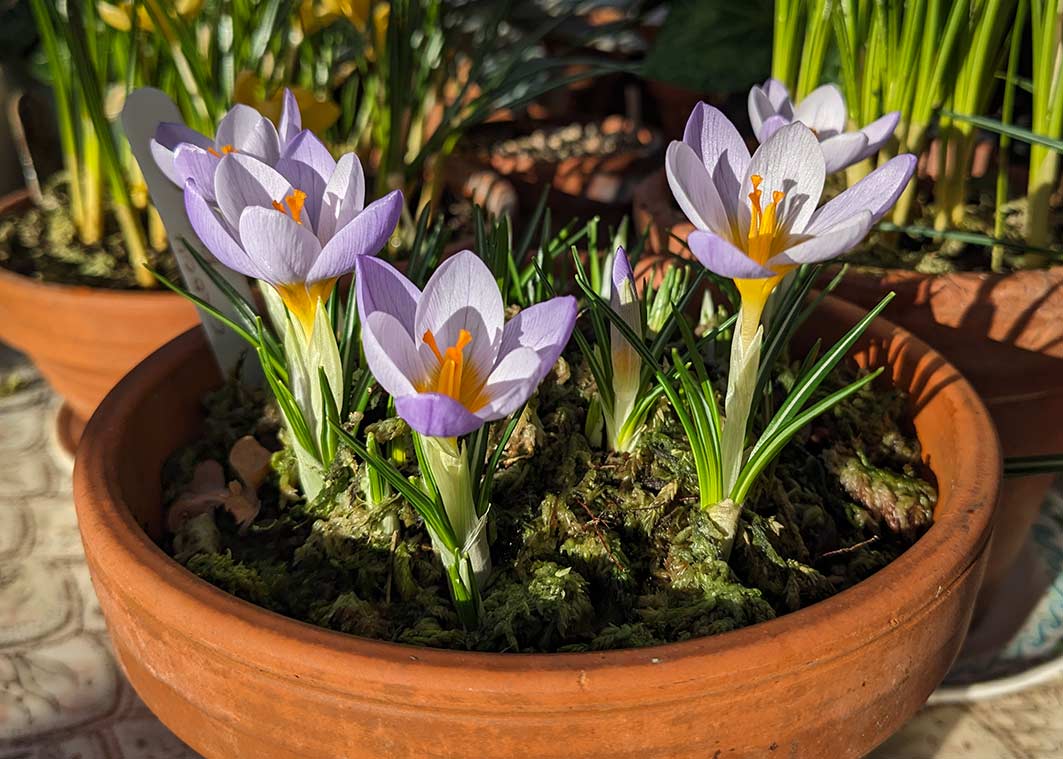
In the conservatory the crocuses have flowered as has the hyacinth and of course the cyclamen.  The oxalis palmifrons is still not showing any buds.  I did see some paler growth which I initially thought might be buds coming up but they were actually very young leaves that were not very green.  Everything needs a bit more sunshine – including me!
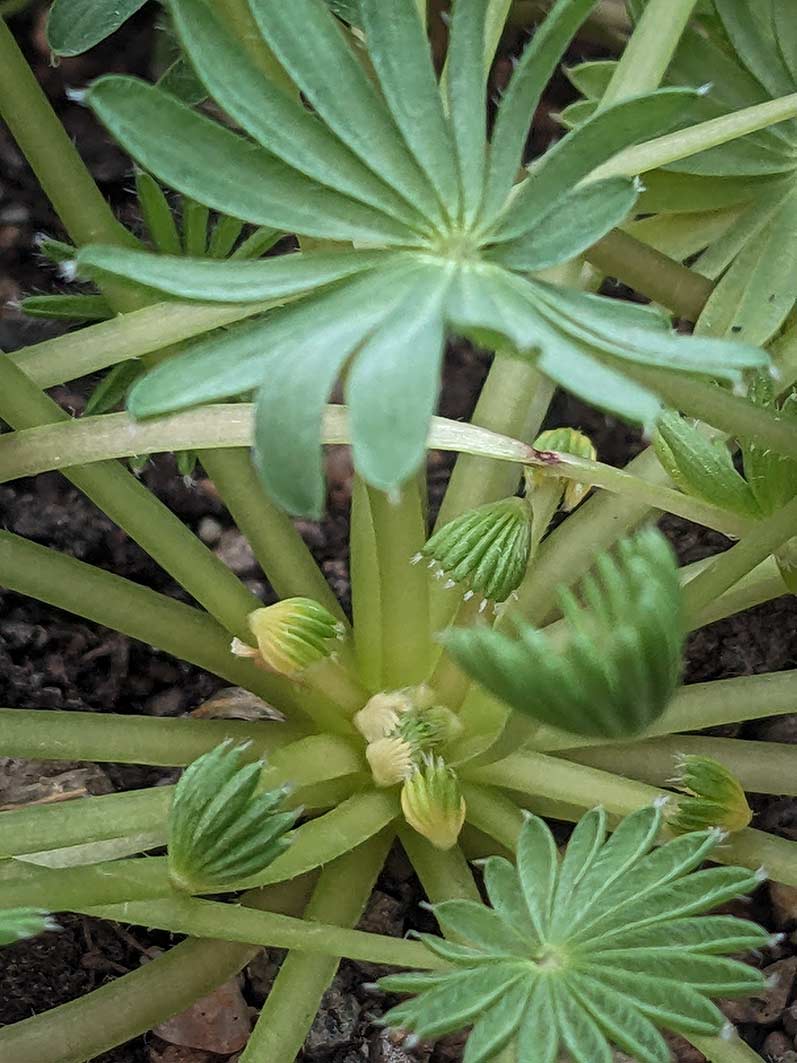
Pale young leaves on an oxalis palifrons.
Oxalis palmifrons young leaves looking a bit pale.
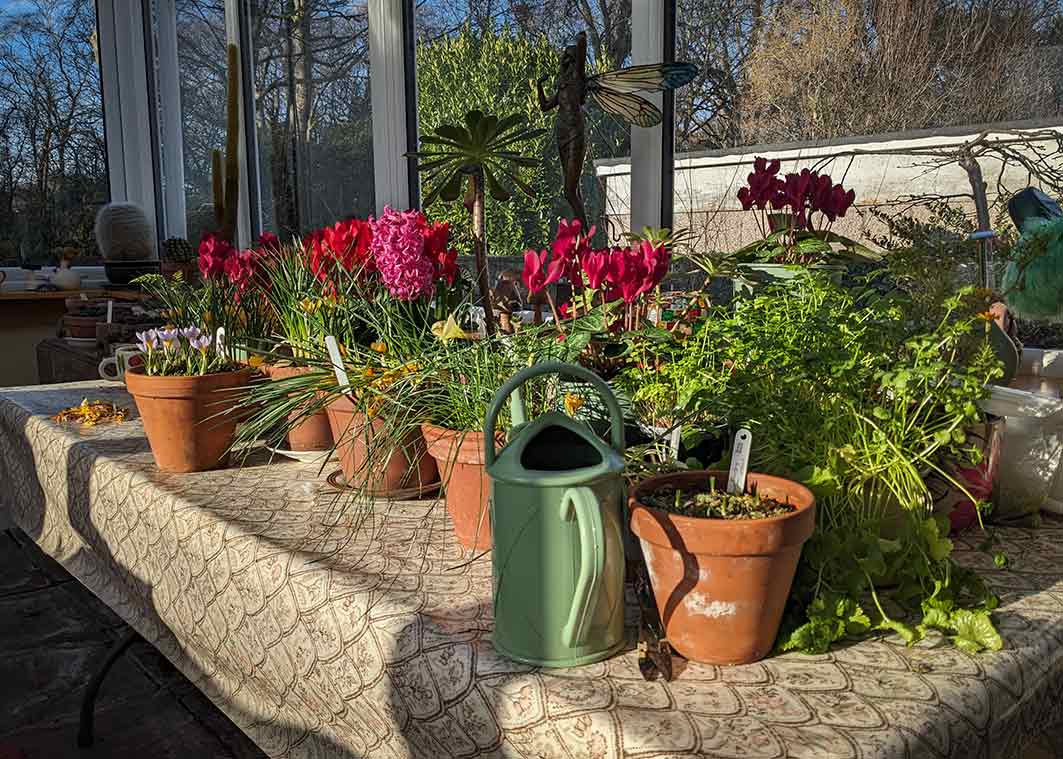
Glimmer of sunshine on the potted bulbs on the conservatory table.
Bulbs on the table in the sunshine.
Colourful bulbs in pots.
Bulbs and cyclamen.
Pale purple Crocus sieberi ‘Firefly’with orange stamens.
Crocus sieberi ‘Firefly’

While I was deadheading the crocuses the spring on my Darlac cut-n-hold snips broke.  Darlac tools have what they call a ‘limited ‘’lifetime’’ guarantee’ so it is worth holding onto the packaging and write the date of purchase on it and keep your receipt.  I couldn’t find anywhere on their website about how to get a replacement spring.  Apparently they were taken over by Fothergill’s  but their website didn’t give any clue about how to obtain a replacement spring either so I phoned the Darlac customer services and they took my details and said that Fothergill’s would send one out to me.  I use quite a few different tools from Darlac – check out some of my favourite tools.  Thank you Darlac.
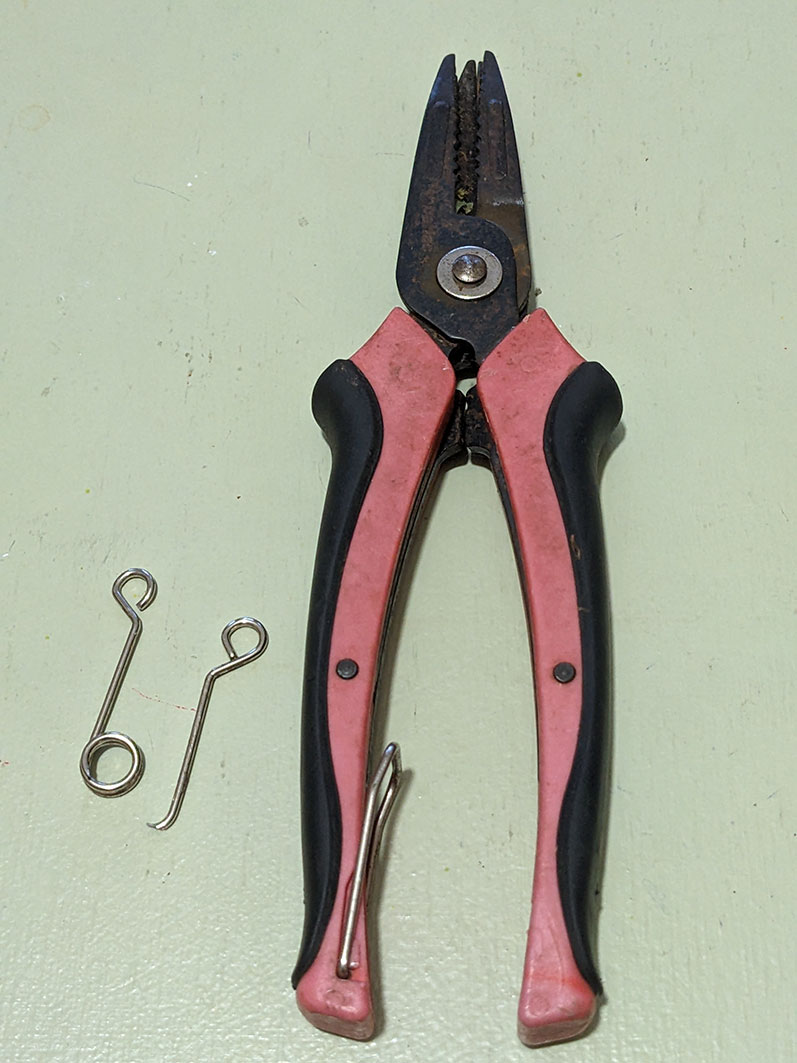
broken spring  of Darlac cut-n-hold snips.
Darlac broken spring.

So the end of January – beginning of February looks very cold, wet and grey still but there is so much coming through that the garden will soon be full of colour again.
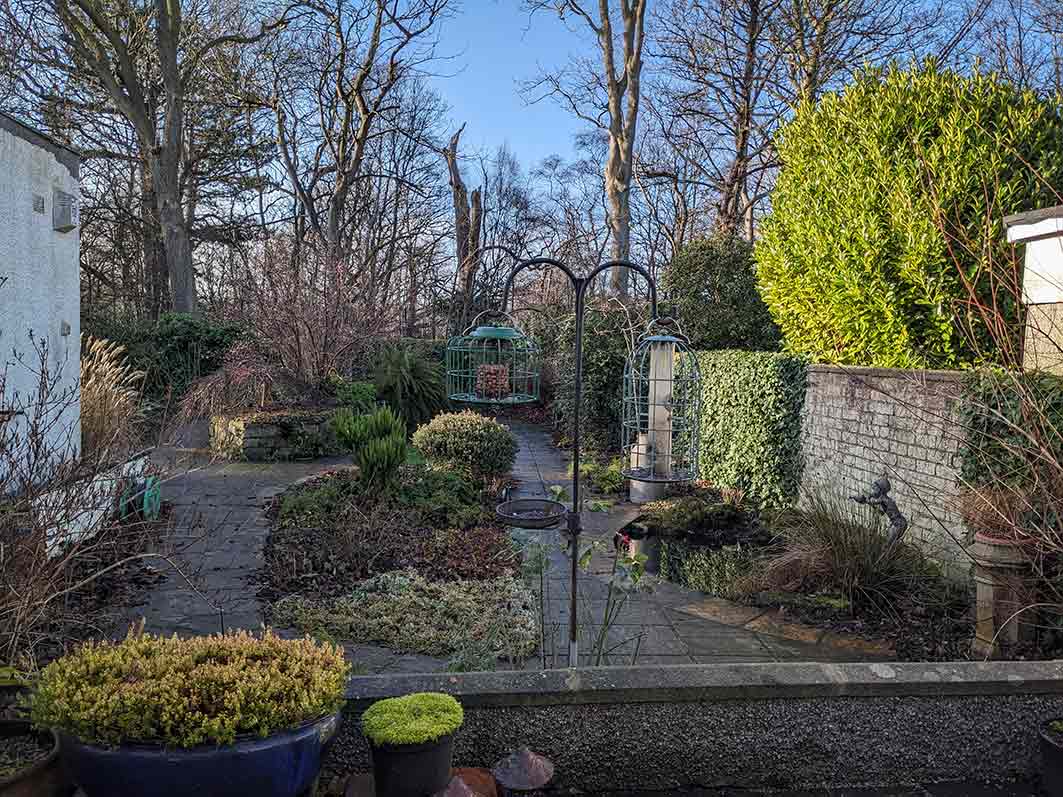
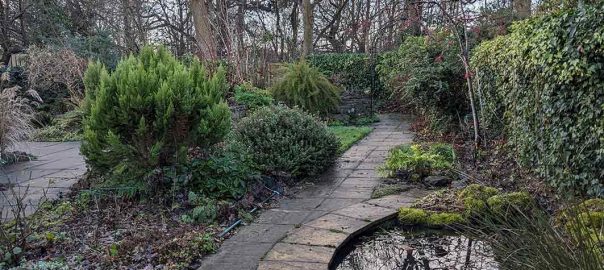
View of the garden at the end of January 2026 shows some evergreen shrubs and ivy and a wild life pond.
End of January 2026
The garden in January 2024

Happy New Year 2024

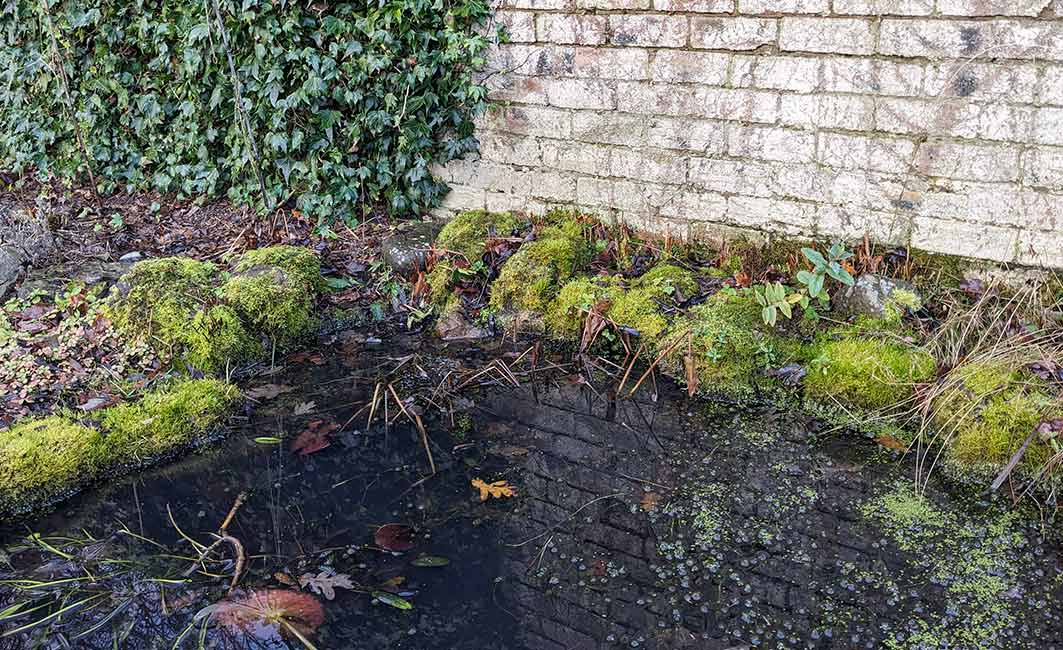
Well, what a year 2023 was with it’s very dry spring and roasting summer, to the very wet autumn and winter!  The garden is ever so soggy right now with the amount of rain we have had over the last couple of months.  There is moss everywhere, which I actually like but it is dangerously slippy when it is down the ramp and on the paving slabs.  The mossy stones around the pond however look great, as do the mossy logs dotted around the garden.  It is at this time of year that you can see all the weeds at the back wall so they are easier to remove.  The plants in the pond itself looks a bit bedraggled and need some attention.

moss covered stones around small wild life pond
Moss covered stones

I haven’t been in the garden much at all during November and December and I miss pottering around checking on the progress of the plants.  I didn’t find much in the way of fungi this year – was I just not out at the right time?  I hate the cold and damp as it really gets into my bones and I just feel miserable spending all my time trying in vain to stay warm.  Now that we have started a new year my hopes are up for a splendid spring.  Even though we still have a couple of cold months to go I feel optimistic when I see all the spring bulbs beginning to grow.  Some of the snowdrops are already in bud and the earlier narcissi have poked their shoots up.

snowdrops in bud
Snowdrop buds

There are a few flowers to be seen at this time of year: some on the witch-hazel (Hamamelis inter Diane), a few sporadic flowers on the Hebe pink paradise, a few tatty flowers on the Viburnum X Bodnantense Dawn  in the raised bed.  Some of the evergreen shrubs have flower buds waiting for their chance such as the Osmanthus burkwoodii and the Erica arborea ‘Estrella gold’.  I do like having the evergreen structure in the garden to look at during the bleak winter months and a few of the ferns have quite a bright, yellowy- green colour which brightens the place up.

sporadic flowers on hebe pink paradise in january
Hebe pink paradise flowers in January
Erica arborea buds
Eric arborea buds
evergreen seelction of plants
Evergreen dark, bright, and purple.

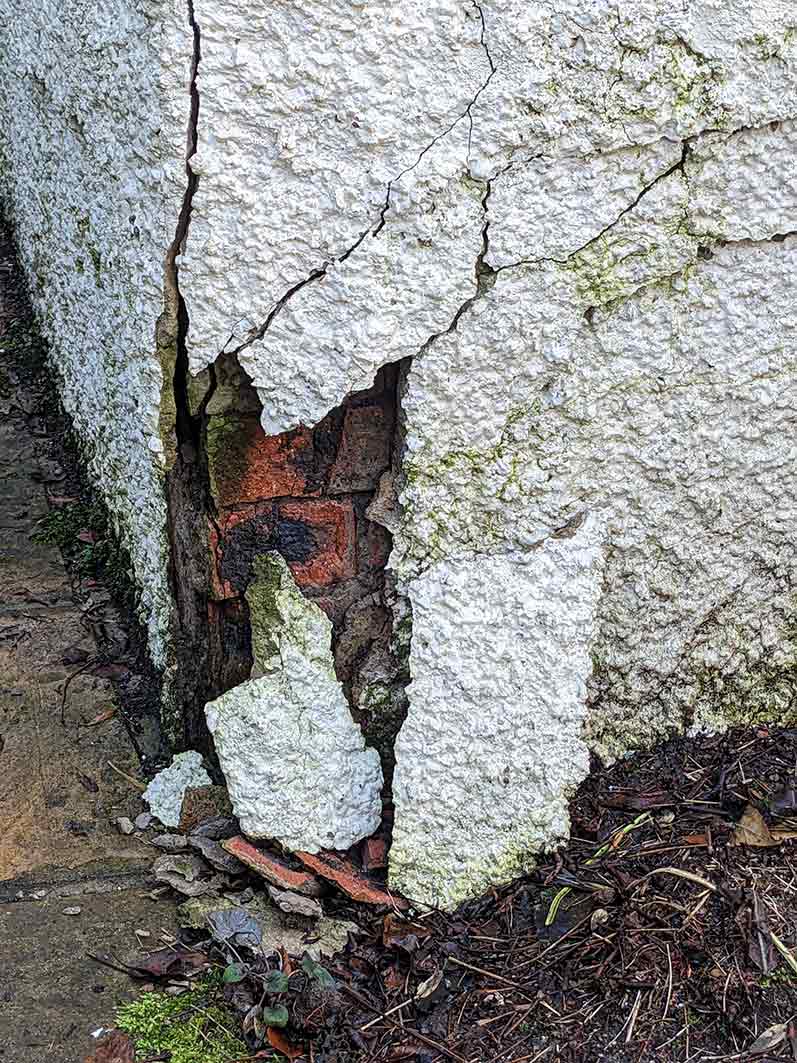
I did spot one job that we will have to get to grips with as soon as the weather gets better and that is the harling on the right hand front corner of the patio.  When the rain gets in behind it and that water then freezes, the harling cracks and gets pushed off.

Broken harling on patio wall
Broken harling on the patio wall.
The garden in January 2024
The garden in January 2024.

From a rather cold and damp Edinburgh garden: Happy New Year!

The importance of evergreens in the winter garden.

I hate seeing just a load of brown in the garden at this time of year, it is so dismal when the quality of light isn’t great either. Now that the perennials are closing down for the winter there are a lot of bare patches in the garden so it is nice to have some ‘greenery’ that lasts all year round.  (For the sake of argument I am using the term ‘evergreen’ to describe a plant that is not deciduous ie. it keeps it’s leaves on throughout the year.  They may not necessarily be green.)  Not only do evergreens provide a focal point, when you scan the garden your eyes jump form one focal point to the next rather than to the bare earth, but they also help to form structure in the garden.  They are good for the wildlife, not only by providing some protection from the harsh winter weather, but also protection from predators.  Often people think of evergreens as being just shrubs, but there are plenty plants that are classed as evergreen that are not shrubs.  They all give the garden some much needed colour during the dull, grey, winter days.  In my garden the winter colour of the evergreens comes from a variety of plants: a few different types of ivies adorning the ugly walls, golden grasses, gold and green holy, berberis, purple huecheras, carpets of dark green cyclamen foliage, periwinkle, epimedium foliage, mahonia, privet hedge, mosses, ferns, hellebores, osmanthus, rhododendron, pieris, chiastophylum, saxifrages, hebe, tree heath, heather, some succulents, and rosemary to name a few.  Don’t forget the lawn!  Many gardens now have lots of decking and slabbing and can look very drab and dead, but even just a small lawn can add a touch of evergreen life.
There are some plants which are classed as semi-evergreen, which means they may hold onto their leaves in mild winters but shed them if the weather gets too cold.   And just to confuse things there are some plants that hold onto their dead leaves during winter but shed them once the new growth starts such as beech trees.  As far as I know beech is not classed as evergreen because the leaves they hold onto are dead.

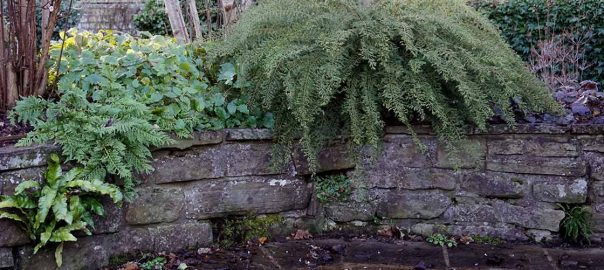
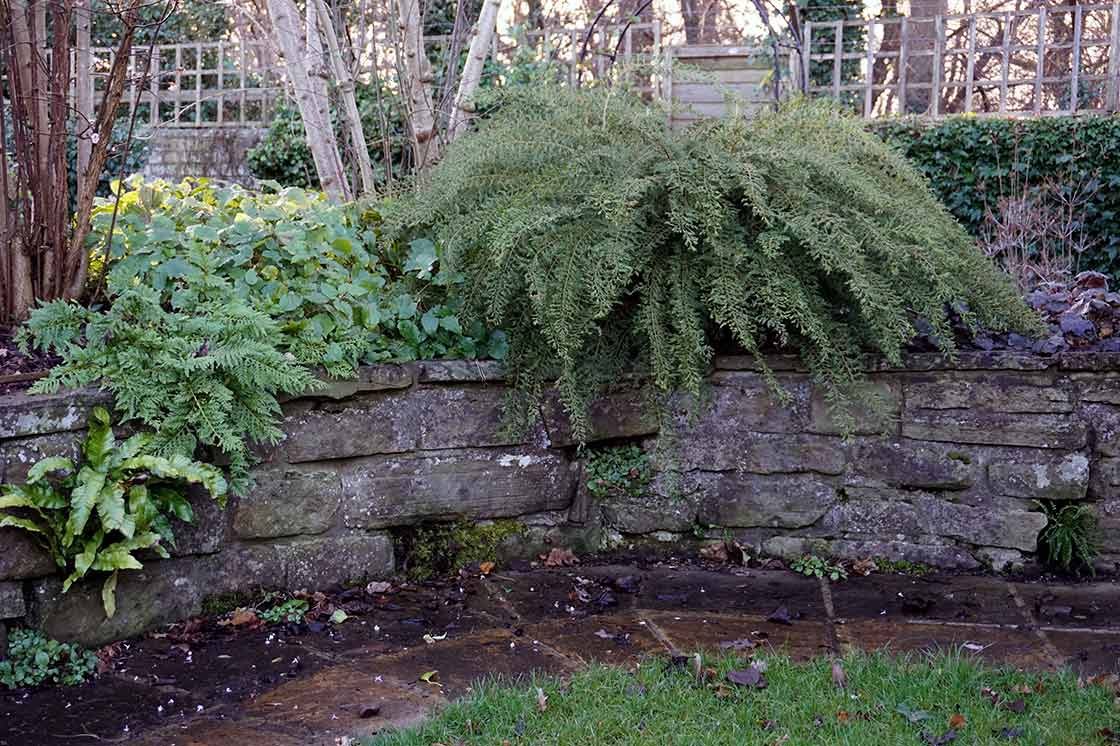
evergreens, ferns,
Ferns, epimedium, chiastophylum, purple heuchera, and ivy.
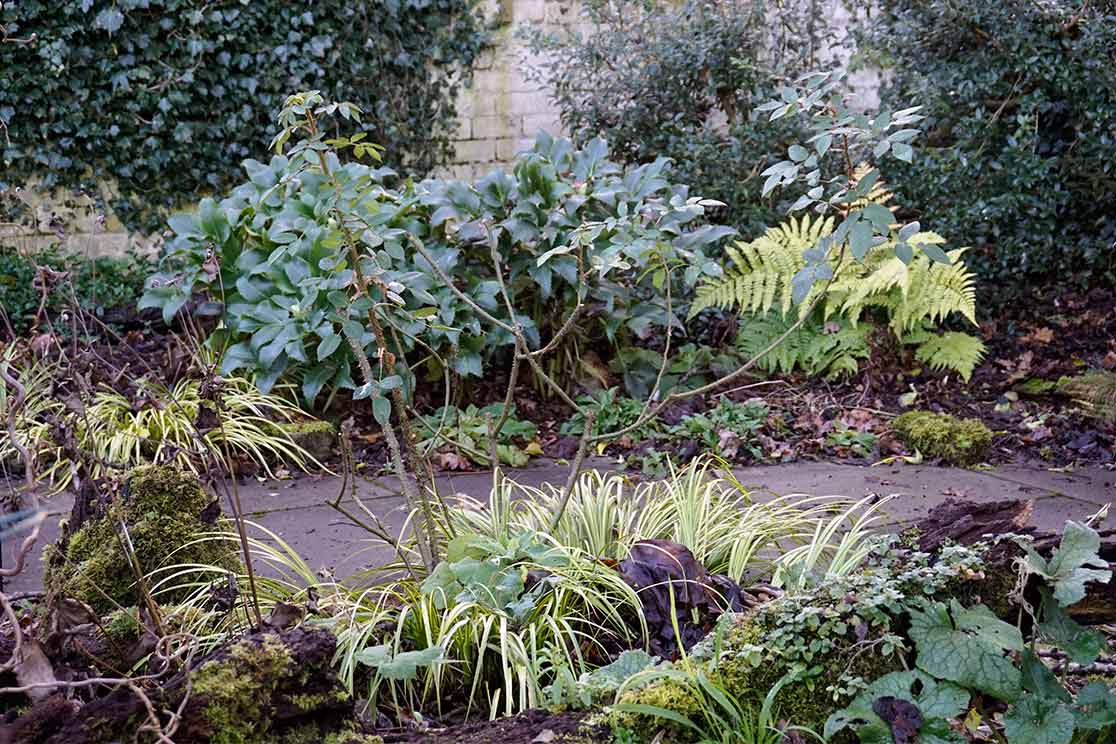
evergreens, ferns,
Ferns, moss, grasses, hellebore, osmanthus, ivy, and periwinkle
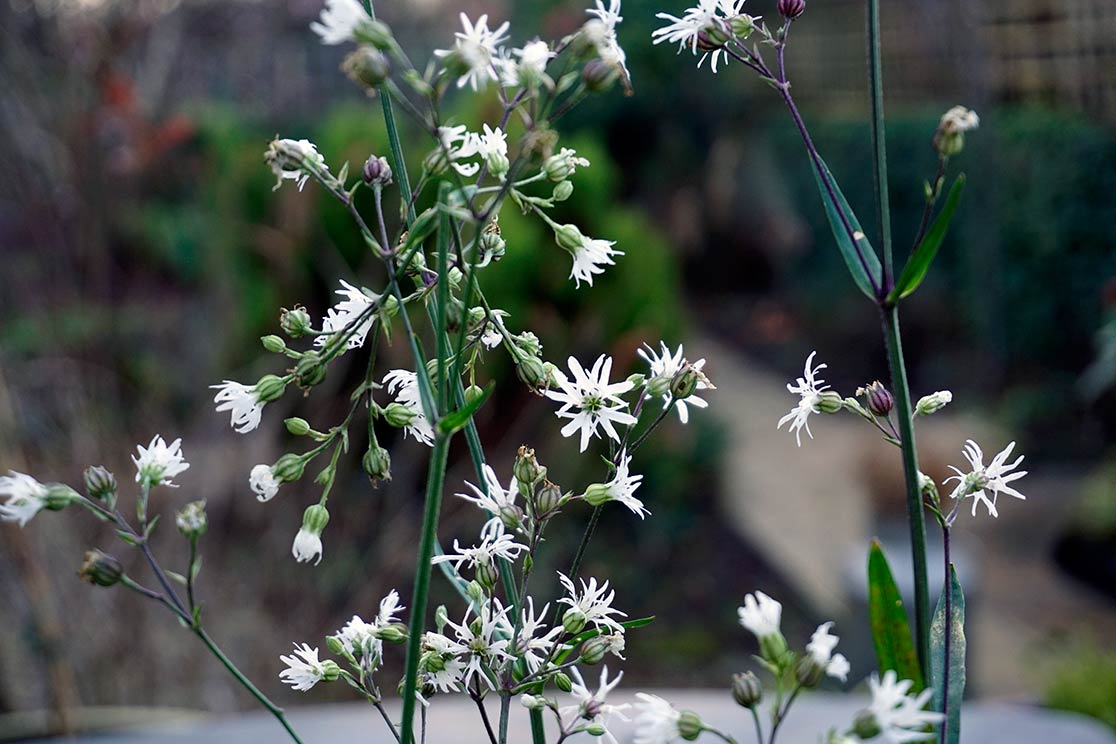
Of course colour in winter can also come from non evergreen plants too.  There are pink flowers on the bare branches of viburnum right now, as are the fiery orange flowers of the witch hazel. There are sporadic pink flowers on the hebe, some of the hellebores are about to flower, and the corkscrew hazel catkins are forming, The bark of my neighbour’s silver birch is very bright and silvery, as are the papery white honesty seed heads. The spring bulbs are just popping through – the snowdrops will be the first to flower in my garden.  One plant that has amazed me though by still being in flower in January is the lychnis ‘white robin’.  I have 3 little pots of it on my patio table waiting for me to plant them and they look superb just now.
plants,
Lychnis, flos – cuculi alba white robin.